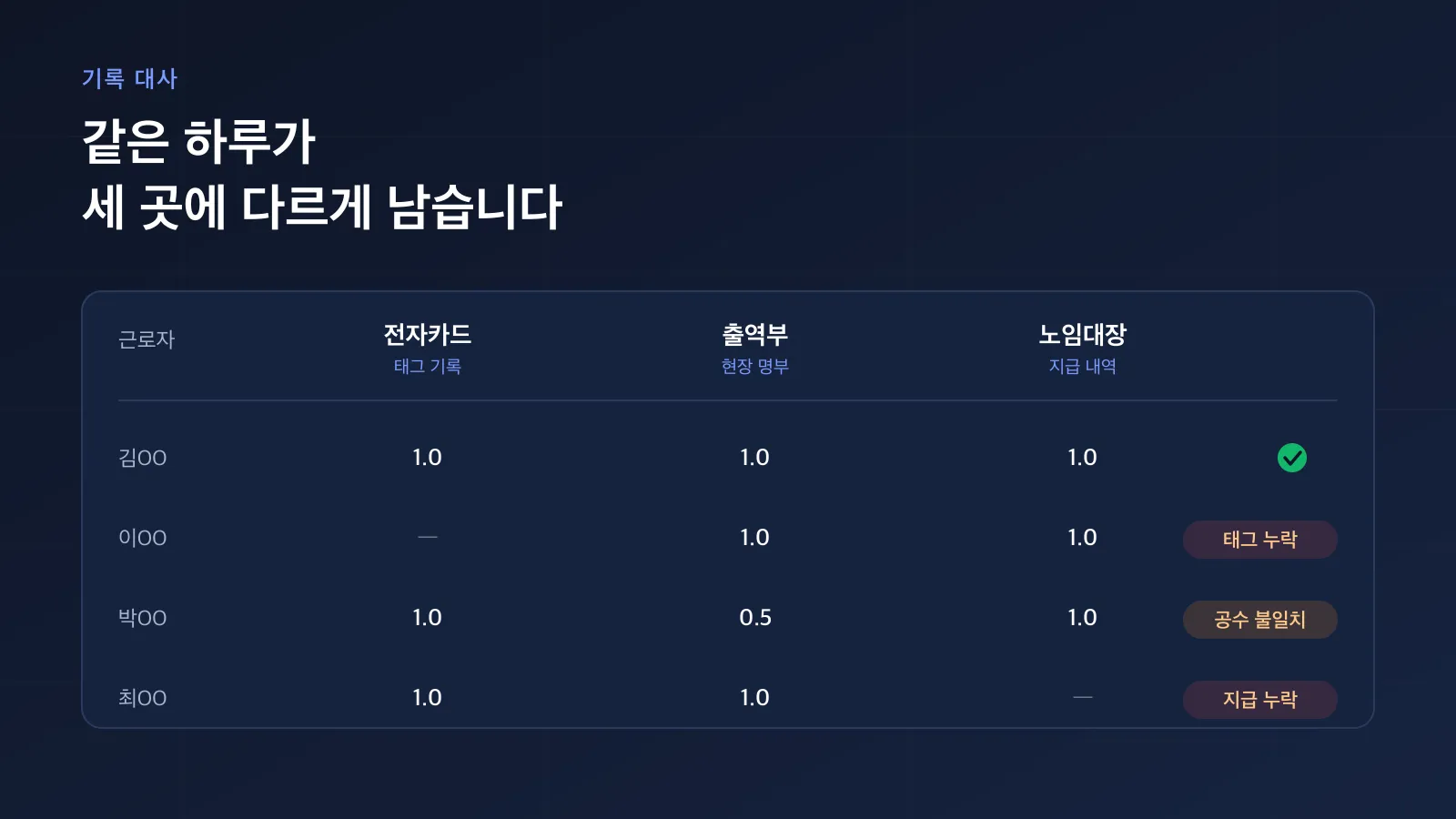
Korea’s Serious Accidents Punishment Act (중대재해처벌법) has been in force for three years, and most sites prepare their safety paperwork the same way. An inspection is announced, the documents get gathered from that point on, and anything missing is filled in from memory. The problem is that the moment it becomes clear the paperwork was produced after the fact, that fact alone counts against you.
A record has to satisfy three things
For a record to carry weight in an audit or an accident investigation, all three of the following have to be present.
Where it most often comes apart
The items that cause trouble are fairly consistent from site to site.
- TBM happens daily, but nothing is recorded — or attendance is never confirmed
- The safety training attendance list does not match the actual attendance roster
- There is no evidence that training was understood by migrant workers
- Near misses are shared verbally and never written down
- The risk assessment exists as a document from the start of the project and is never updated
It is faster to build a way of working in which records appear on their own than to get better at producing records.
Attaching records to the work itself
Adding more paperwork on the side never lasts. Records have to attach to what is already being done. If people check in through an app, attendance data exists as a by-product; connect TBM attendance and training completion to that data and there is no separate document to produce.
That changes what preparing for an inspection means. It stops being a document hunt and becomes an export of data you already hold, in whatever format is asked for.